
What Is Schema Markup and Why Does Google Care About It?
By Dave Alden, Digital Marketing With Dave, Thamesford, Ontario
If you've ever had someone mention schema markup to you and quietly shook your head while thinking, what the heck are they talking about, then this post is for you.
Schema markup is one of those things that sounds technical and overwhelming but is actually pretty straightforward once someone explains it in plain English. And it matters more for your local business right now than most people realize especially with AI search engines like ChatGPT, Perplexity, and Google's own AI overview becoming a bigger part of how people find businesses.
Let me break it down simply.
What Schema Markup Actually Is
Think about your business for a second. You know what it is, you know your name, your address, your phone number, what services you offer, what hours you're open, and what areas you serve.
Your customers who visit your website can figure most of that out too by reading your homepage, they see your contact page, they understand you're a plumber in Ingersoll who serves Oxford County.
But Google is not a person. Google is a machine that reads code. And when Google's crawlers visit your website, they have to guess at what things mean. They see text on a page but they don't always know whether that text is your business name, your address, a product description, or just a heading.
Schema markup is the code you add to your website that removes all that guesswork. It's essentially a set of labels you attach to your information that tells Google and other search engines and AI platforms exactly what each piece of information is.
Instead of Google guessing that "226-378-4199" might be a phone number, the schema tells Google for sure that this is the telephone number for this business. Instead of Google guessing that "Thamesford, Ontario" is probably a location, the schema tells Google, this is the address of this local business, and here are the geographic coordinates.
It's like putting name tags on everything in your house so a stranger could walk in and immediately know what every item is and how it fits together.

Why Google Cares About It
Google's entire business is built on giving searchers accurate, useful information fast. The more clearly your website communicates what your business is, the more confidently Google can show it to the right people at the right time.
When a business uses proper schema markup, it helps Google better understand and trust the information on their website. That extra confidence can lead to higher rankings in local search, more visibility through rich results like star ratings and business hours, and even getting featured in answer boxes or snippets at the top of search results.
Here's an example. When someone in Tillsonburg searches "HVAC contractor near me" at 8pm on Tuesday, Google's algorithm considers dozens of signals to decide which three businesses to show. One of those signals is how clearly each business has communicated its information. A business with complete, accurate schema markup, LocalBusiness type, service area defined, hours specified, phone number tagged, reviews structured, gives Google a much stronger signal than a business with no schema at all.
That clear strong signal translates directly into better rankings.
Why It Matters Even More for AI Search
This is where it gets even more interesting for 2026 and beyond.
AI search engines like ChatGPT, Perplexity, Google's AI Overview, Claude and many more, don't work like traditional search engines. They don't just match keywords. They read websites, understand what they mean, and combine those answers from multiple sources.
When someone asks Perplexity "who does Google Business Profile optimization in Southwestern Ontario," Perplexity crawls the web looking for the most authoritative, clearly communicated answer. A website with proper schema markup is dramatically easier for an AI engine to read and understand than a website without it.
Schema markup essentially gives AI engines a clear and structured version of your business information. They don't have to guess about your website, they can read the organized information directly and pull it into their answer with confidence.
This is why all the pages on my clients' websites, and on my own website at digitalmarketingwithdave.com include full schema markup. It's not just for Google anymore. It's for every AI platform that might be asked about local businesses in SW Ontario.
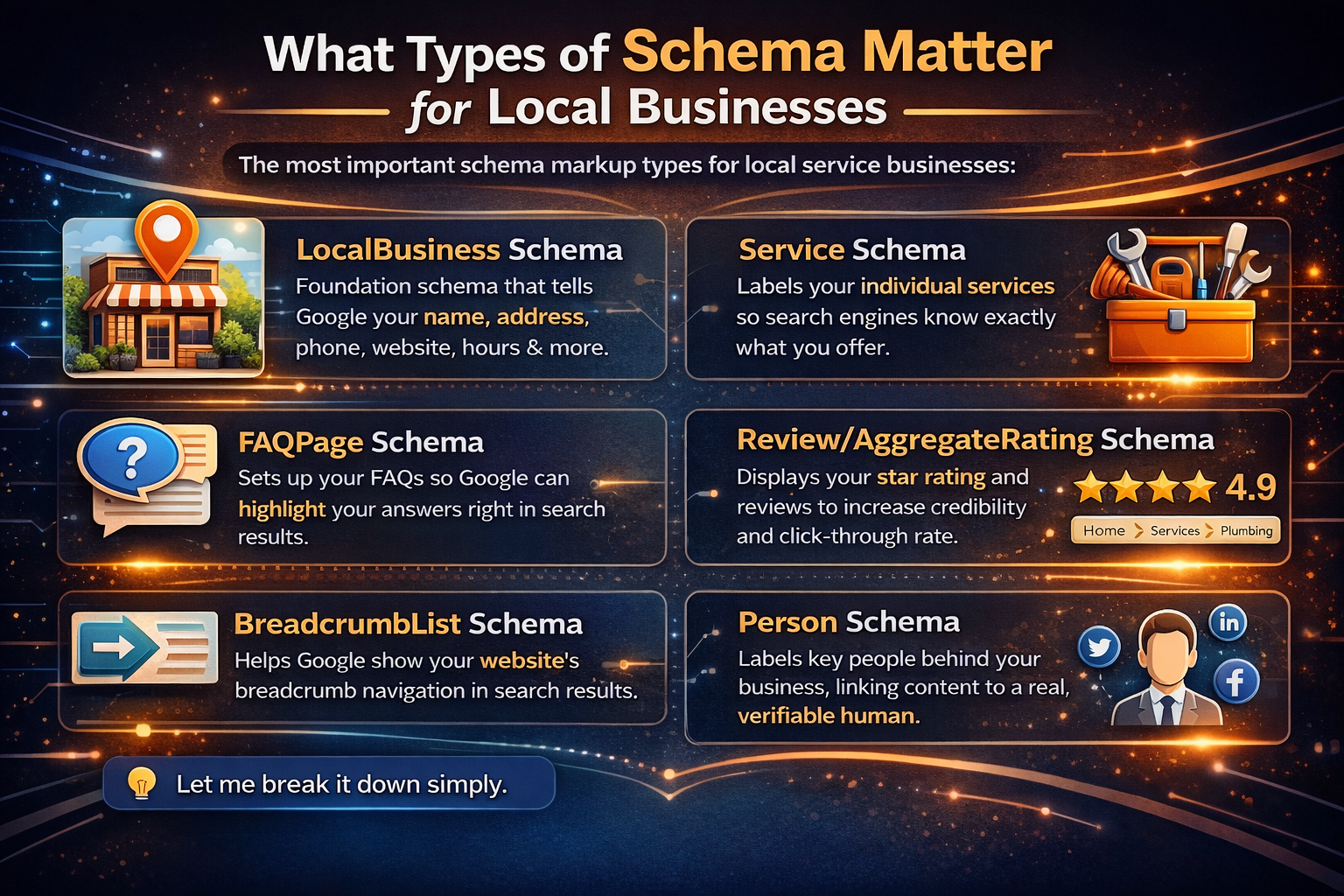
What Types of Schema Matter for Local Businesses
There are hundreds of types of schema markup but for a local service business in SW Ontario, these are the ones that actually matter:
LocalBusiness schema: This is the foundation. It tells search engines your business name, address, phone number, website, hours, price range, geographic coordinates, and service area. If you only do one thing, this is it.
Service schema: This labels each of your services individually so Google and AI engines can see exactly what you offer. A plumbing company with service schema for "drain cleaning," "water heater installation," and "emergency plumbing" is telling Google about three distinct services rather than just one vague business type.
FAQPage schema: This highlights and sets up your FAQ section so Google can pull your questions and answers directly into search results. When someone searches a question your FAQ answers, Google sometimes shows the answer directly in the search results with your business name attached. That's a huge win for your business.
Review/AggregateRating schema: This communicates your review rating to Google in structured format, enabling those gold star ratings to appear in search results. Those stars increase click-through rates significantly.
BreadcrumbList schema: This helps Google understand the structure of your website and shows those breadcrumb navigation paths in search results.
Person schema: This labels the person behind the business, name, job title, social profiles so AI engines can link content to a real, verifiable human being. This matters a lot for AI search trust signals.
What It Looks Like in Practice
Schema markup sits in the code of your website, specifically in the <head> section or embedded in the page body and it's invisible to your website visitors. They never see it. It's entirely for the search engine robots scanning your site.
Here's a simplified example of what LocalBusiness schema looks like:
{
 "@type": "LocalBusiness",
 "name": "My Plumbing Company",
 "telephone": "519-555-0100",
 "address": {
 "streetAddress": "123 Main Street",
 "addressLocality": "Ingersoll",
 "addressRegion": "ON"
 },
 "openingHours": "Mo-Fr 08:00-17:00",
 "areaServed": "Oxford County"
}
That little block of code tells Google everything it needs to know about that business like who they are, where they are, how to contact them, when they're open, and where they serve. Without it, Google has to infer all of those things from the visible text on the page, which can be scary to say the least.
Does Every Website Have Schema Markup?
No they don't and that's actually good news for you.
Most small business websites in SW Ontario have no schema markup at all. The person who built the site didn't add it, the website template didn't include it, and the business owner had no idea it existed. It's one of the most commonly missed elements in local SEO.
That means businesses that do have proper schema markup have a meaningful technical advantage over the ones that don't and in smaller markets like Aylmer, Glencoe, Gads Hill, that advantage can be the difference between showing up in the local 3-pack and not showing up at all.
How to Check If Your Website Has Schema Markup
Google has a free tool called the Rich Results Test at search.google.com/test/rich-results. You paste in your website URL and it tells you what schema markup Google can detect on your site and whether it's valid.
If you run your site through that tool and it comes back empty or shows errors, your site has a schema problem worth fixing.
Go try it out. It's free and very informative.
The Bottom Line
Schema markup is not optional anymore. It used to be a nice-to-have. Now, with AI search engines reading and synthesizing web content at scale, structured data is one of the clearest ways to tell Google, ChatGPT, Perplexity, and every other AI platform exactly who you are, what you do, and where you do it.
Every website I build for clients includes full schema markup as a standard not an option. LocalBusiness, Service, FAQPage, AggregateRating, BreadcrumbList, and Person entity. It's baked in from day one because the alternative is leaving your website's interpretation up to a machine that's doing its best to guess.
Don't make Google guess. Tell it exactly who you are.
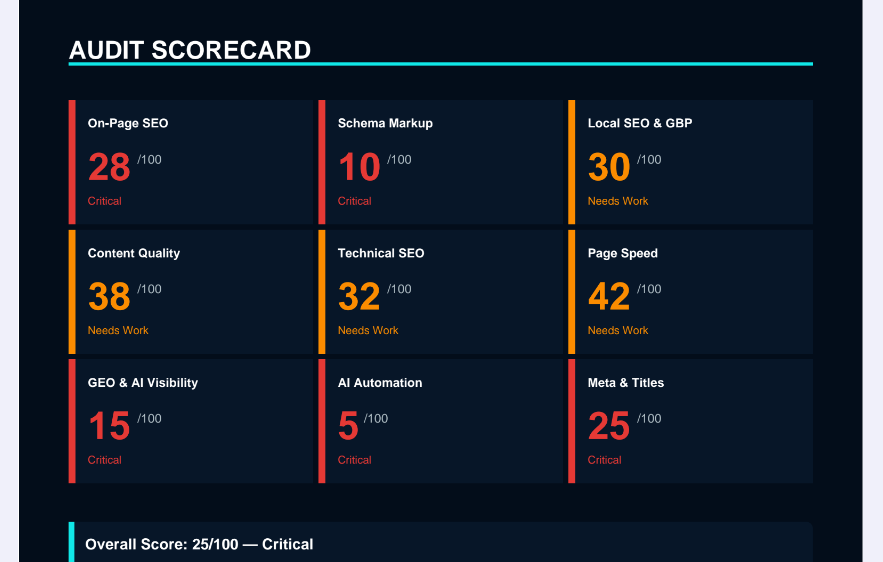
If you want to know whether your current website has proper schema markup and what fixing it would do for your local visibility, book a free audit and I'll check it as part of the review.
Dave Alden is a local digital marketing specialist based in Thamesford, Ontario, helping small businesses across SW Ontario get found on Google and turn searches into customers. Services start at $297 CAD/month with no contracts. Dave can be reached at Digital Marketing With Dave or at [email protected]


